Amplitudes 2017 summer school (July 2017):
The study of scattering amplitudes has seen vigorous progress in recent years, both within Scotland and internationally. This school will provide training for graduate students and academics based in Scotland in this exciting field and will precede the annual Amplitudes conference. The school will be held at University of Edinburgh in July 2017.
Biophotonics North (2nd – 5th November 2016):
Biophotonics is an important field of research within SUPA’s PALS theme area and many graduate students pursuing a Ph.D. in this theme will benefit from attending this conference, from mingling with their peers over an event focused on their field of research, as well as from meeting with delegates from outside SUPA. This will enrich their knowledge and inform their research practice by implementing ideas/know-how from other groups and horizons. Workshops on research-related problems beyond the laboratory – gender balance in research and career progression – will increase the professional skills and ethics of the attendees. This event will be held at University of St Andrews.
FluoroFest (Spring 2017):
Professor Norbert Lutkenhaus (Feb 2017):
Prof Norbert Lütkenhaus is a leading international expert in quantum optics and quantum key distribution, who focuses on bridging the gap between theory and experiment in the realization of quantum technologies. Prof Lütkenhaus’ expertise is likely to appeal to students interested both in theoretical studies as well as in experimental implementations.
SUPA graduate students will have the opportunity to interact with Prof Lütkenhaus, and to learn about and be trained in recent developments in the fields in which he is an expert. Prof Lütkenhaus will deliver a series of lectures (indicatively each 1 hour long), to be broadcast / recorded through the SUPA videoconferencing network, and local seminars at the hosting institutions.
Professor Lutkenhaus will be visiting University of Glasgow, Heriot-Watt University, University of St. Andrews, and University of Strathclyde.
Dr William D. Phillips (July 2017):
Scottish-born scientists, David Thouless and Michael Kosterlitz, along with Duncan Haldane from London, have been awarded the 2016 Nobel Prize in physics for theoretical discoveries of topological phase transitions and topological phases of matter. David, a Professor Emeritus at the University of Washington, originates from Bearsden. Michael Kosterlitz, a physics professor at Brown University in Providence, Rhode Island comes from Aberdeen. SUPA has extended congratulations to both.
https://www.nobelprize.org/nobel_prizes/physics/laureates/2016/
The Scottish Centre for the Application of Plasma-Based Accelerators, SCAPA, creates a state-of-the-art environment for collaborative research that will support research, development and application of laser-driven accelerators and next-generation radiation sources. It will promote collaboration between academia and industry, and enable engagement of the UK research community with large international projects. SCAPA houses two high power lasers to drive accelerators and radiation sources, one high-repetition laser for target manufacture and diagnostics, 7 beam lines in three shielded areas, a control room and preparation laboratories.
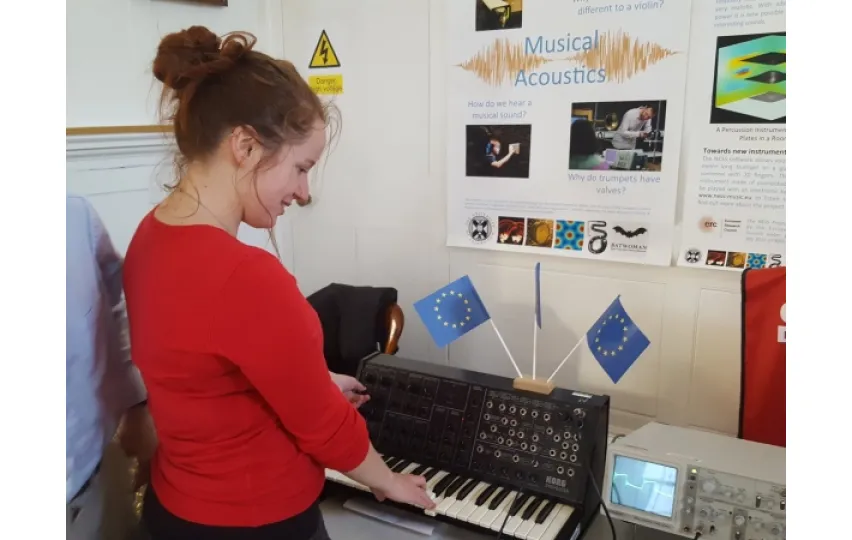
On 30th September 2016 Researchers from across SUPA took part in Explorathon2016, Scotland’s contribution to European researcher’s night. A one night celebration of research, Explorathon was an extravaganza of discovery, debate and entertainment. Events were held in Aberdeen, Edinburgh, Glasgow and St Andrews.
In St Andrews, Valerie Bentivegna (Dundee) presented her biophysics research as standup comedy in a Bright Club set. Helen Cammack, Jonathan Keeling, Brendon Lovett, Kyle Ballantine and Aidan Strathearn (St Andrews), presented “Quantum digits and dances” at the Byre theatre, explaining the mysteries of quantum mechanics.
In Edinburgh Charlotte Desvages and Reggie Harrision from the acoustics group demonstrated the physics of musical instruments at the “Curiosity Forest”.
A key knowledge exchange output of SUPA comes from its six hundred graduate students. Many of these students have industrial sponsors, either through one of the four Centres for Doctoral Training, or via another arrangement between their host university and industry. An excellent illustration of the benefits that can accrue from industrial involvement in a PhD is provided by a recently completed studentship from SUPA’s INSPIRE programme.
The studentship was a collaboration between the University of Edinburgh and Toshiba Medical Visualisation Systems Europe and concerned the development of acquisition and analysis methods to image coronary arteries and cardiac function. The student, Chengjia Wang, supervised by Keith Goatman (Toshiba Medical) and Scott Semple (University of Edinburgh), successfully defended his thesis at the end of June. This topped off an extremely successful collaboration with two manuscripts in preparation with Chengjia as lead author to add to the multiple conference presentations, co-authored papers, and a patent on the registration of medical images.
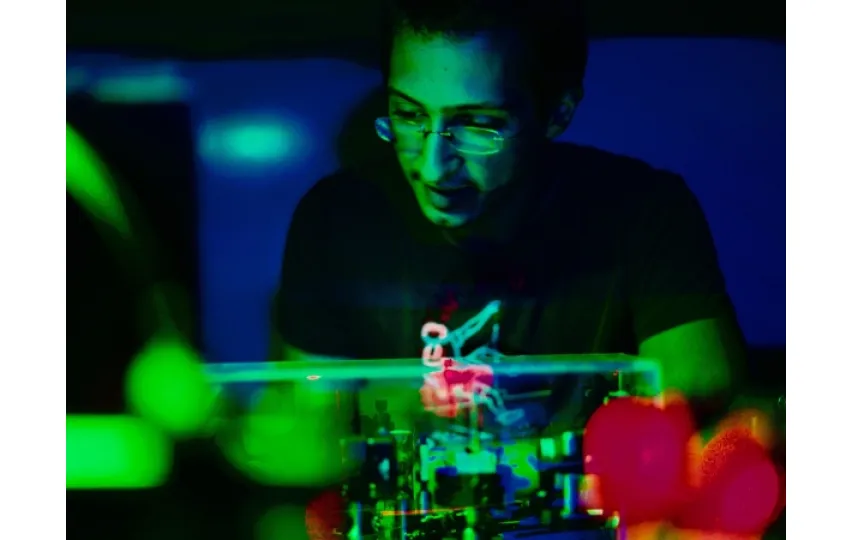
In 2015 the universe was officially proven to be weird. After many decades of research, a series of experiments showed that distant, entangled objects can seemingly interact with each other through what Albert Einstein famously dismissed as “Spooky action at a distance”.
A new experiment by an international team led by Heriot-Watt researcher Dr Alessandro Fedrizzi has now found that the universe is even weirder than that: entangled objects do not cause each other to behave the way they do.
Distinguishing cause from effect comes naturally to us. PhD student Martin Ringbauer from the University of Queensland explains, “Picture yourself in a room where someone is flicking a light switch. Intuition and experience lets you establish a simple causal model: the switch causes the lights to turn on and off. In this case, correlation implies causation.”
“If we could entangle two lights, you would see them turn on and off at random, regardless of how far apart they are, with no obvious switch and in perfect lockstep. Einstein’s preferred explanation of this mysterious effect was that there must be a hidden light switch which acts as a common cause for our entangled lights.”
SUPA launched a new Public Engagement Network on 8th September at Heriot Watt University. Researchers from across SUPA gathered to discuss how SUPA can support public engagement with physics in Scotland.
The event opened with a panel session on Considerations for Public Engagement chaired by Siân Bevan. Grant McAllister introduced SSERC and stressed its role in providing support and resources for teachers across Scotland. Aidan Robson and Helen Cammack discussed the challenges and opportunities inherent in taking part in public engagement activities as an academic. Both are enthusiastic supporters of SSERC. Stephen Breslin CEO of the Glasgow Science Centre spoke about Science as culture and the need for a science centre to create enjoyment and enthusiasm (which lead to repeat visits) Heather Earnshaw introduced the IoP’s improving gender balance project by graphically illustrating the audience’s gender bias. A lively discussion followed.
An ERA-NET competition on photonic sensing launched on 1st September, with a closing date for stage 1 proposals on 5th December 2016. ERA-NET is a European scheme to build cooperation and coordination of research activities carried out at national or regional level in the Member States. In practical terms this means that activity is funded in each country at the national level, in the UK this is through Innovate.
The photonic sensing competition is open to R&D project consortia consisting of a minimum of two separate legal partners from at least two different participating countries and/or regions as follows:
- Austria
- Flanders Region (Belgium)
- Germany
- Israel
- Poland
- Portugal
- Turkey
- Tuscany Region (Italy) and
- United Kingdom
The objective of this call is to strengthen the research and development of photonic techniques for the technology readiness levels (TRL) 3-6 (proof of concept to technology demonstration in relevant environment). The competition is aimed at the most relevant sensing technologies with the highest impact on the human life. The following five application areas are in scope:
The sensing of gases in the air we breathe has become increasingly important as society strives to improve quality of life. Current and future legislation, energy conservation, pollution reduction, safety applications and food production are all examples of market drivers for sensor systems. Emerging Smart City and IoT initiatives are likely to be major future contributors to accelerating the growth of the atmospheric gas sensing solution market.