European Crucible Programme
The primary objective of European Crucible is to create and develop a pan-European network of future research leaders who have enhanced knowledge, contacts and capacities to collaborate more effectively with wider impact.
European Crucible has been developed from the success of the decade-long Scottish Crucible programme. Read further about the impact of our national and international Crucible programmes and their Alumni in the following reports:
- European Crucible 2021-2022 Summary Report
- European Crucible Alumni Forum 2024 Report
- Scottish Crucible Alumni Overview
- Scottish Crucible Alumni Reflections
 Crucible Alumni Podcast Series
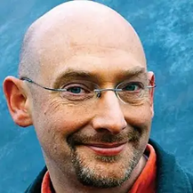
Listen to broadcaster, Quentin Cooper, as he interviews team members from 7 pilot projects that received seed funding and learn how their multi-disciplinary research activities were initiated and enabled through their participation in European Crucible. Projects address medical, health, environmental, social, legal and technological challenges.
European Crucible Podcasts
Water Quality Monitoring
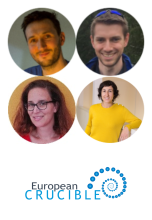
Despite the standard use of spectroscopy to determine the composition of water in the laboratory and in the field, UV/visible spectrometers are expensive and bulky. This project encompasses the development and testing of new low cost and sensitive UV sensors for water composition quantification.
Storytelling and Games to Address Trauma
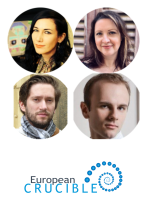
Children are being traumatised by the violence in Ukraine and are in need of safety. Several approaches can provide support for victims of trauma conflict. Storytelling allows us to make sense of information in an organised way whilst combining elements of play. The aim of the project is to develop a 'serious game' providing children and young people affected by war and conflict with an opportunity to engage in mixed media to process emotion and trauma.
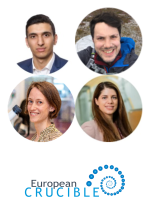
Shedding Light on Cell Processes for Health
Autophagy is a vital cellular process, in which dysfunctional components of the cell are removed and the building blocks recycled for reuse. Defects in the functioning of this system have been shown to have important links with various diseases, including cancer and neurodegeneration. The project will shed light on autophagy pathways using Raman Spectroscopy and fluorescence techniques from fat body tissue of Drosophila larvae.
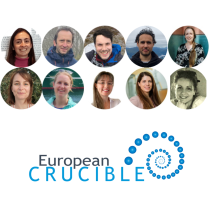
Coral Reef Restoration with Magnets
Coastal marine habitats are biodiverse ecosystems providing a wealth of social, economic and cultural benefits but are under immense human pressure because of coastal development, polluting land run off and climate change. The project aim is to increase coral settlement rates by actively attracting colonisation via a substrate's magnetic properties.

Policy Making and Green Technology
Many green technologies (e.g. batteries and hydrogen) rely on critical elements, materials, and supply chains that have negative environmental impacts. A collider event brought together policymakers, industry partners and specific actors with influence over the use and development of 'green' technology. A collection of qualitative and scientific data regarding the existing gaps in the thinking are being addressed.

Science Communication
Has public confidence in the ethics and capacities of science declined in recent times? Topics such as climate change, vaccines, telecommunications, food safety, and most recently COVID-19 have been the subject of debate. This project examines one of the key factors which lies behind the conflict between science and its critics: specifically, the way in which science is, and has been, communicated to society.
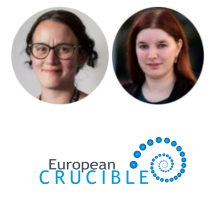
Nanoscience
Nanoparticles are of interest to many areas of physics, and can also be used as carriers for the safe and effective administration of drugs, or for theranostics (diagnostic and therapeutic capability in a single therapy) purposes, yet they can also interact with biological systems and lead to unwanted adverse effects. The objective of this project is to revolutionize the toolbox of analytical chemistry techniques in order to investigate nanoparticle interactions with the human body and its impact on medicine safety.
Scottish Crucible Podcasts
Hear interviews with Alumni:
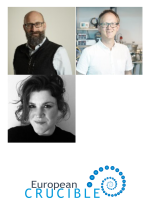
Scottish Crucible Reflections 1 : research collaboration, leadership and careers
Featuring Prof. Tim Drysdale, Prof. Stuart Reid, and Dr Heather May Morgan. Learn more about how their research and careers have progressed in the years since undertaking Scottish Crucible.
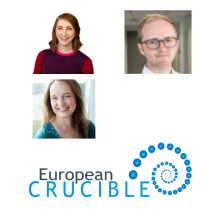
Scottish Crucible Reflections 2 : research collaboration, leadership and careers
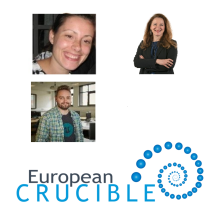
Scottish Crucible Reflections 3 : research collaboration, leadership and careers
Funding Acknowledgements
SUPA had responsibility, on behalf of all Scottish Research Pools, for the administration and delivery of the European Crucible grant from Scottish Funding Council / Scottish Government.
Further Information
For further information on Scottish and European Crucible, contact Co-Directors:
Dr Ruth Neiland: neilandmrm23@gmail.com
Prof Alan Miller: Alan.Miller@glasgow.ac.uk